
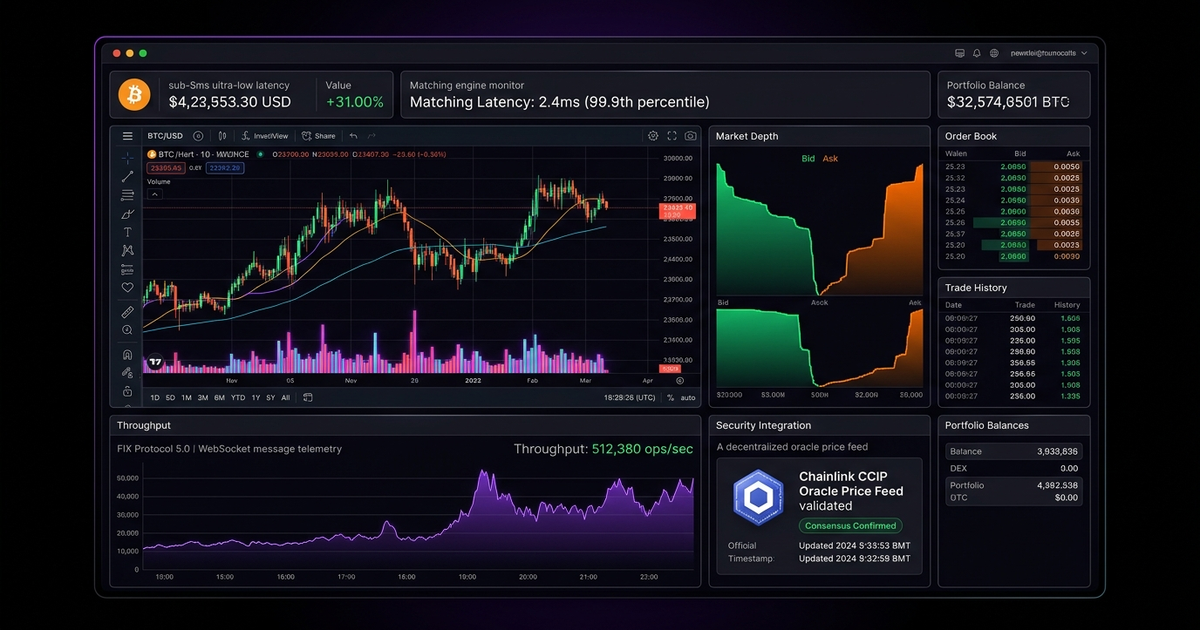
Smart contracts are strictly deterministic state machines isolated from off-chain market prices, fiat bank balances, and external blockchains. Without cryptographically verified data ingestion, decentralized exchanges, lending protocols, and tokenized asset platforms remain exposed to flash-loan manipulation, silent under-collateralization, and centralized bridge exploits. This technical guide unpacks Decentralized Oracle Networks (DONs), sub-second Pull Data Streams, automated Proof of Reserves (PoR), and defense-in-depth settlement via Chainlink CCIP.
Build Auditable DeFi and RWA Infrastructure with Better2Better
Deploy institutional smart contracts engineered with manipulation-resistant price feeds, automated Proof of Reserves circuit breakers, ERC-3643 compliance, and secure CCIP cross-chain liquidity bridges.
1. The Oracle Problem and Single-Block Spot Price Manipulation
Early decentralized protocols repeatedly suffered total treasury drains by querying a single AMM pool ratio on-chain to determine collateral valuations. Because uncollateralized flash loans let attackers borrow massive capital inside one transaction, skewing an isolated spot pool for milliseconds enables over-borrowing and immediate insolvency extraction before the block closes.
Institutional-grade decentralized systems solve this vulnerability by shifting price discovery to independent Decentralized Oracle Networks (DONs) that continuously calculate volume-weighted average prices (VWAP) across deep centralized and decentralized venues off-chain before anchoring threshold-signed consensus states on-chain.
Security Comparison: Price Ingestion & Cross-Chain Settlement Models
| Architecture / Feed Type | Consensus & Update Model | Flash-Loan & Spoofing Resistance | Institutional Production Role |
|---|---|---|---|
| Single AMM Spot Reserve | Direct intra-block pool balance query | Critically vulnerable (atomic single-tx distortion) | Unsafe for collateral valuation or liquidations |
| Push Decentralized Oracle (OCR) | DON threshold median across liquid venues | High resistance (volume-weighted outlier rejection) | Lending markets, stablecoin vaults, RWA minting |
| Sub-Second Pull Data Streams | Signed off-chain reports verified during trade execution | Maximum precision + front-running protection | Perpetual DEXs, options clearing, high-frequency perps |
| Legacy Multisig Bridge | Small validator quorum guarding locked liquidity | High systemic failure risk under key compromise | Deprecated in favor of Defense-in-Depth protocols |
| Chainlink CCIP + RMN | Execution DON + independent Risk Management Network | Multi-layered anomaly pausing & rate limiting | Cross-chain DvP, enterprise stablecoins, institutional RWAs |
2. DON Architecture & Off-Chain Reporting (OCR): Byzantine-Fault-Tolerant Aggregation
Within an Off-Chain Reporting (OCR) committee, independent node operators fetch normalized quotes from enterprise market data aggregators and reach Byzantine-fault-tolerant consensus prior to on-chain submission:
- Volume-Weighted Filtering (VWAP): Shallow order books or outlier print spikes are mathematically down-weighted so isolated illiquid trades cannot swing global index valuations.
- Single-Transaction Quorum Transmission: Peer-to-peer signed observations compress into one threshold-verified payload submitted on-chain, cutting verification gas overheads dramatically.
- Dual Deviation & Heartbeat Triggers: Feeds post fresh answers whenever underlying market prices cross a deviation band (e.g., 0.25%–0.5%) or at strict heartbeat intervals, guaranteeing deterministic liveness.
3. Sub-Second Pull Oracles (Data Streams) for Derivatives and Perpetual DEXs
High-frequency perpetuals and options clearinghouses face a stark economic trade-off with traditional push feeds: pushing state updates every few hundred milliseconds wastes prohibitive blockspace, while 30-second heartbeats invite toxic latency arbitrage.
Pull-based Data Streams resolve this bottleneck with verifiable off-chain telemetry:
- Sub-Second Signed Reports: Node committees continuously sign bid/ask/mid state frames off-chain without paying gas for idle ticks.
- User-Bundled Execution: When opening leverage or triggering liquidations, the trader or keeper attaches the signed oracle report directly to the transaction calldata.
- Atomic On-Chain Verification: Smart contracts validate quorum signatures and exact timestamp bounds synchronously inside the match transaction, preventing mempool front-running.
4. Automated Proof of Reserves (PoR) and On-Chain Solvency Circuit Breakers
Off-chain stablecoin custodians, wrapped-asset bridges, and hybrid exchanges historically relied on delayed quarterly PDF attestations. Automated Proof of Reserves (PoR) transforms transparency into enforceable smart-contract code:
- Direct Fiduciary & Custodian Telemetry: Regulated trustees and liquidating banks publish cryptographically signed reserve balances consumed directly by reserve oracle feeds.
- Merkle-Sum Trees & ZK Solvency Proofs: Exchanges publish cryptographic trees allowing any account holder to verify inclusion inside global liabilities without leaking confidential individual portfolios.
- Pre-Mint Circuit Breakers: Tokenization smart contracts inspect real-time PoR headroom inside every
mint()call, automatically reverting unbacked issuance attempts.
5. Chainlink CCIP: Cross-Chain Settlement and the Risk Management Network
Legacy bridges repeatedly lost billions due to homogeneous validator sets protecting monolithic liquidity vaults. CCIP introduces strict separation of concerns via an independent secondary network:
- Dual-Network Verification (DON + RMN): While the committing and executing DON handles Merkle roots and delivery, a separately implemented Risk Management Network continuously inspects cross-chain state invariants and automatically pauses bridges upon anomalies.
- Programmable Token Transfers: Atomic cross-chain movement pairing ERC-20/ERC-3643 asset mint/burn or lock/unlock directly with destination smart-contract calldata.
- Configurable Per-Lane Rate Limits: Caps outbound and inbound value velocity per corridor window to strictly contain maximum exposure.
Production Parameters for Price Feeds, PoR Guards & CCIP Routing
| On-Chain Module | Cadence / Trigger | Protective Invariant | Prevented Failure Mode |
|---|---|---|---|
| Push Price Feed | 0.25%–0.5% deviation or 60m heartbeat | Staleness threshold check + min/max bound assertion | Borrowing against frozen quotes during network stalls |
| L2 Sequencer Uptime Feed | Checked prior to every liquidation/borrow | Configurable post-recovery grace period window | Unfair mass liquidations upon rollup restart |
| Proof of Reserves Feed | 10m–60m cadence or reserve delta trigger | Revert minting whenever newSupply > verifiedReserve | Infinite unbacked stablecoin or RWA minting |
| CCIP Router & Pools | Source chain finality confirmation | Independent Risk Management Network blessing + rate limits | Forged cross-chain transfers and pool drains |
6. Technical Specification: Canonical PoR & CCIP Attestation Payload
Canonical PoR & CCIP Cross-Chain Attestation Payload (JSON)
Consuming contracts should enforce freshness, L2 sequencer health, PoR headroom, and RMN blessing under one unified data structure before executing state changes:
{
  "protocolStandard": "ENTERPRISE_ORACLE_POR_CCIP_V2",
  "targetChainId": 42161,
  "assetTicker": "TBILL_USD_RWA",
  "oracleGuard": {
    "roundId": "110680464442257319482",
    "medianAnswerScaled": "100482500",
    "decimals": 8,
    "updatedAt": 1762958100,
    "maxStalenessSec": 3600,
    "sequencerGracePeriodPassed": true
  },
  "proofOfReserves": {
    "custodianAttestationHash": "0x94c2f8e1a70d4392b1e4c92817f2d0a3419f7b8e110c4a12",
    "verifiedOffchainReserveScaled": "250000000000000",
    "currentTotalSupplyScaled": "241500000000000",
    "mintHeadroomScaled": "8500000000000",
    "porCircuitBreakerStatus": "HEALTHY_BACKED"
  },
  "ccipSettlement": {
    "messageId": "0x61b2a0948e11f322c4a9128d0091e742aa81092b3f1c77e1",
    "sourceChainSelector": "5009297550715157269",
    "rateLimitRemaining": "50000000000000",
    "riskManagementNetworkBlessed": true
  }
}- maxStalenessSec & sequencerGracePeriodPassed: Rejects stale valuations when Layer 2 rollups recover from temporary sequencer downtime.
- mintHeadroomScaled & porCircuitBreakerStatus: Mathematically locks token minting ceiling inside verified off-chain collateral reserves.
- rateLimitRemaining: Enforces strict per-corridor throughput quotas blocking rapid pool depletion.
- riskManagementNetworkBlessed: Confirms independent secondary-network sign-off before releasing cross-chain settlement.
7. Common Smart-Contract Pitfalls When Integrating Oracles
Even audited decentralized feeds break down if consumer smart contracts skip elementary safety checks:
- Missing L2 Sequencer Checks: On Arbitrum, Optimism, and Base, forgetting to inspect the sequencer uptime oracle allows predatory bots to liquidate healthy borrowers during post-outage catch-up windows.
- Hardcoded Decimal Scales: Price aggregators typically return 8 decimals for USD pairs and 18 for ETH pairs; failing to normalize cleanly causes orders-of-magnitude valuation bugs.
- Ignoring Aggregator Min/Max Answer Bounds: During extreme black-swan crashes, feeds clamp at preconfigured limits; consumer logic should handle boundary alerts via secondary circuit protection.
8. Institutional RWA Interoperability and Continuous Auditability
For asset managers, tokenized treasury issuers, and regulated exchanges, combining automated Proof of Reserves with CCIP programmable transfers allows compliance-gated ERC-3643 tokens to settle seamlessly across public L2s and permissioned enterprise chains while maintaining real-time cryptographic backing verifiable by auditors and financial regulators.
9. Production SRE & Security Audit Checklist for Oracle-Driven Protocols
Verify every item in staging and forked mainnet simulations before production rollout:
[OK]Complete AggregatorV3 Checks: Validate positive answer, non-zero timestamp within staleness threshold, and explicit decimal normalization across all feeds.[OK]Mandatory L2 Sequencer Uptime Guard: Test simulated sequencer downtime ensuring borrows and liquidations halt cleanly until grace period elapses.[OK]Pre-Mint PoR Hard Enforcement: Attempt an over-limit mock mint and verify atomic EVM revert when supply exceeds attested reserves.[OK]Strict CCIP Router & Source Validation: VerifyccipReceive()rejects arbitrary callers outside authorized Router, source chain selector, and whitelisted sender.[OK]Non-Custodial Guardian Emergency Pause: Deploy multisig pause-only capability halting new mints/borrows without exposing ability to seize user collateral.
10. Frequently Asked Questions on Decentralized Oracles, PoR & CCIP (FAQ)
Why cannot protocols safely rely on a single Uniswap pool price as an oracle?
Spot AMM ratios can be warped within one block via uncollateralized flash loans, allowing attackers to drain dependent lending vaults immediately.
What is the main advantage of Pull Data Streams over Push Oracles?
Data Streams provide sub-second signed price frames verified on-chain only when users trade, preventing latency arbitrage without paying continuous push gas costs.
Does on-chain Proof of Reserves prevent over-issuance of wrapped assets?
Yes. When mint functions query certified PoR feeds directly, smart contracts reject any token issuance exceeding verifiable real-world collateral.
How does Chainlink CCIP avoid historic multisig bridge failures?
CCIP combines an independent Risk Management Network for anomaly detection and automatic pauses alongside programmable per-lane rate limits.
What happens if an L2 sequencer goes offline temporarily?
By reading the L2 Sequencer Uptime Feed and honoring a grace period upon restart, protocols prevent unfair liquidations while traders post defensive collateral.
Can exchanges prove solvency without exposing customer balances?
Yes. Pairing Merkle-Sum Trees with zero-knowledge proofs lets users verify inclusion mathematically while safeguarding individual privacy.
How does Better2Better integrate these standards for enterprise platforms?
We architect ERC-3643 RWA platforms, DeFi lending markets, and institutional DEXs natively wired to OCR feeds, automated PoR circuit breakers, and CCIP routing.
Architect or scale this infrastructure in your operation
Speak directly with Better2Better principal systems architects to assess scale capacity, security requirements, integrations, and deployment timelines for your business.