
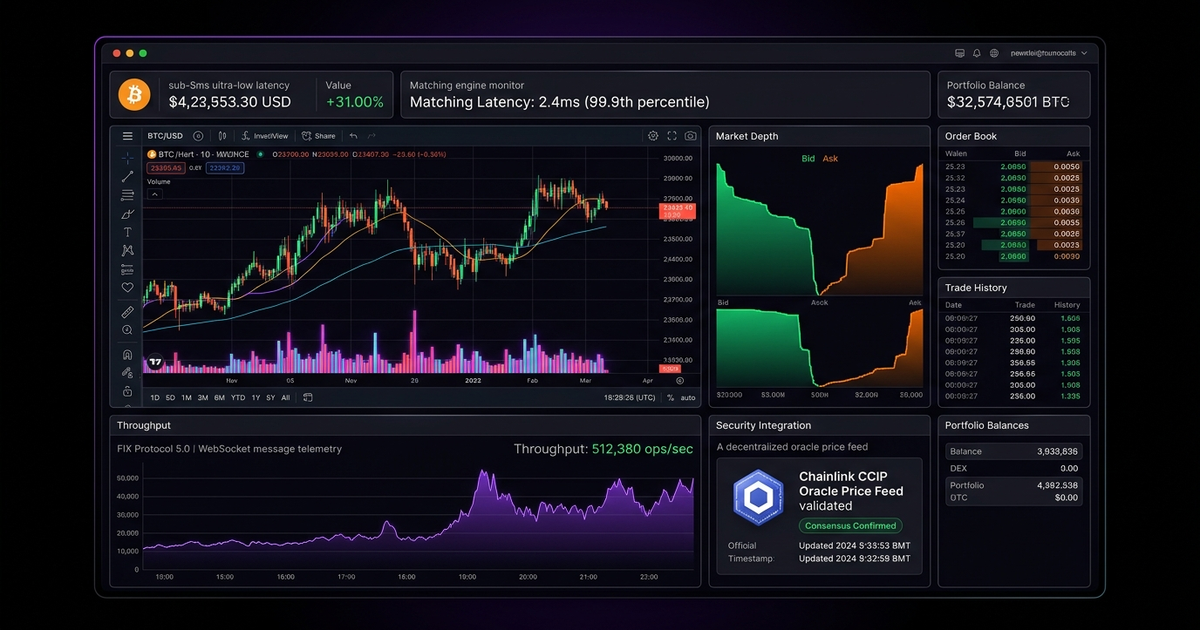
Building an institutional digital asset exchange means solving three demanding engineering disciplines simultaneously: deterministic deterministic low-latency computation, double-entry financial accounting under extreme concurrency, and cryptographic custody hardened against both external attackers and insider threats. In this architecture guide, we examine the core design of an in-memory CLOB Matching Engine in Rust/C++, FIX 4.4 and binary WebSocket gateways, deterministic P2P Smart Escrow, and segregated MPC-TSS custody.
Deploy Your White-Label Exchange with Better2Better Institutional Engine
Our DEX/CEX Engine platform provides deterministic low-latency order matching, automated external liquidity hedging, built-in P2P fiat escrow, and multi-party threshold custody tailored for global regulated venues.
1. Why Relational Databases Collapse Inside an Order Book Core
The most frequent engineering failure among emerging cryptocurrency exchanges is placing relational database transactions directly on the critical path of order submission and matching. During sharp macro volatility or cascading liquidations, institutional market makers continuously cancel, replace, and re-quote thousands of limit orders per second around the top of the book.
When multiple API workers execute concurrent SELECT ... FOR UPDATE locks against shared price-level and counterparty balance tables, disk WAL I/O saturates, lock waits trigger exponential connection timeouts, and deadlocks stall order cancellations. Under those conditions, market makers get picked off on stale quotes and immediately pull liquidity from the venue.
Architectural Comparison: SQL-Coupled Legacy Exchange vs. In-Memory Deterministic Engine
| Engineering Dimension | SQL-Locked Legacy Design | Better2Better Deterministic CLOB Engine |
|---|---|---|
| Matching Execution | Row-level SELECT FOR UPDATE causing lock contention during volatility spikes | Single-writer pinned thread (LMAX Disruptor pattern) executing strictly in RAM |
| P99 Match Latency | 45 ms to 400 ms with severe tail degradation | Under 180 microseconds deterministic tick-to-trade core loop |
| Sustained Throughput | 300 to 1,200 orders/sec per pair before WAL bottlenecks | Over 120,000 orders/sec per market partition (per-symbol sharding) |
| Balance Accounting | Mutating shared user rows directly under race condition risk | Pre-trade balance lock in atomic cache + immutable journal to async SQL ledger |
| Private Key Custody | Single monolithic hot-wallet key stored on API host | MPC Threshold Signatures (TSS) without key reconstruction + hardware quorum |
| Crash Recovery | State divergence between matched fills and unsettled user balances | Deterministic event sourcing (Raft/Aeron log) with idempotent state replay |
2. Inside the Matching Engine: Ring Buffers, Price-Time Priority, and Determinism
Institutional venues strictly decouple peripheral authentication from core matching computation. Each trading pair is assigned to an isolated market partition executing as a Single-Writer Loop on pinned CPU cores with zero garbage collection pauses:
- Pre-Allocated Lock-Free Ring Buffers: Validated order commands flow through L1/L2 cache-friendly circular buffers, avoiding dynamic heap allocations inside the matching loop.
- O(1) Price-Time Priority (FIFO): Bids and Asks maintain sorted price levels indexed by balanced trees or flat tick arrays, while each price level references a doubly linked list of resting orders so mid-queue cancellations operate in constant O(1) time.
- Pure Deterministic Replay: Given the exact same ordered sequence of input commands, active and standby replicas produce bit-identical trades and ledger deltas without relying on system clocks or blocking network I/O.
- Native Institutional Order Types: Support for Post-Only maker protection, Immediate-or-Cancel (IOC), Fill-or-Kill (FOK), hidden Iceberg clips, and Self-Trade Prevention (STP) modes right inside the core.
3. Pre-Trade Risk Checks, Balance Locks, and Double-Entry Ledger Clearing
Guaranteeing that no participant trades unbacked funds or withdraws capital already committed to resting bids requires isolating user balances per asset into available and locked buckets prior to matching:
- Synchronous Pre-Trade Reservation: Before an order enters the matching loop, notional exposure plus worst-case taker fee moves atomically from
availabletolockedinside the risk partition. - Price Improvement Release: Whenever a resting bid fills below its limit price, the excess locked quote currency is instantly refunded to
availablewithin the execution event. - Balanced Double-Entry Journal: Every trade emits immutable credit/debit legs across buyer asset, seller quote currency, and exchange fee revenue accounts so total closed-system liabilities remain mathematically provable.
- Asynchronous Ledger Persistence: Dedicated persistence consumers flush journals in batched transactions to the audit database without ever adding latency to order matching.
4. Connectivity Gateways: FIX 4.4, Binary WebSockets, and Fair Rate Limiting
Retail web applications and high-frequency liquidity providers have sharply diverging wire requirements. An enterprise exchange exposes multiple protocol adapters over the same internal binary bus:
- FIX 4.4 / FIX 5.0 Institutional Gate: Translates standard
NewOrderSingle,OrderCancelReplaceRequest, andExecutionReportmessages directly to internal engine frames with built-in Cancel-on-Disconnect protection. - Sequenced L2/L3 Market Data Feeds: Combines REST depth snapshots with monotonically numbered incremental deltas over low-overhead WebSockets (Protobuf/SBE) so bots immediately detect dropped frames.
- Cancel-Ratio & Weight-Based Throttling: Dynamic token buckets differentiate healthy risk-off cancellations from wasteful out-of-spread order spam so market makers can protect inventory during spikes.
5. Deterministic State Machine for P2P Trading and Smart Escrow
In emerging corridors or jurisdictions with constrained direct card acquiring, an integrated P2P desk drives primary fiat onboarding and off-ramping. Without strict state-machine governance, P2P venues quickly succumb to doctored transfer receipts and chargeback abuse.
Our architecture locks seller digital assets into a segregated escrow_locked ledger state the instant an order is matched. Settlement via local instant rails (Pix, SPEI, SEPA Instant) either reconciles automatically via partner bank webhook or enters a strict time-bounded counter-confirmation window. Unpaid orders unlock automatically at TTL expiration, while disputed tickets freeze fund movement until forensic resolution backed by signed chat audit logs and payment identifiers.
6. Segregated MPC-TSS Custody, Chain Reorg Guards, and Travel Rule Compliance
Storing private keys as plain-text secrets on internet-facing API servers exposes the entire venue to catastrophic loss. Enterprise custody splits assets across tiered MPC-TSS infrastructure where key shares reside inside isolated cloud enclaves and customer-controlled signers, never assembling a full private key at any moment.
Incoming deposits undergo configurable blockchain confirmation finality guards against chain reorganizations alongside continuous KYT screening to flag sanctioned sources before withdrawal unlock. High-value cross-VASP withdrawals enforce automated FATF Travel Rule counterparty verification prior to MPC co-signing.
Custody Tier Isolation & Infrastructure SLA Matrix
| Custody / Gateway Layer | Cryptographic Architecture | Exposure Policy & Controls | Processing SLA |
|---|---|---|---|
| Hot Operational Wallet | MPC-TSS 2-of-3 (Confidential Enclaves + HSM) | Capped at 2% to 4% of total TVL; policy-driven sweep limits | Automated signing < 650 ms post KYT clearance |
| Warm Treasury Router | MPC 3-of-5 governed by whitelisted settlement targets | Consolidates verified deposit UTXOs/addresses and liquidity buffers | Scheduled sweep batch with dual policy validation |
| Cold Air-Gapped Vault | Offline multi-party quorum ceremony | Holds 90%+ of client reserves completely offline | 4h to 24h multi-executive hardware sign-off |
| FIX & Matching Core | mTLS + Ed25519/HMAC session signing | Mandatory Cancel-on-Disconnect and per-account fat-finger caps | Gateway-to-core round-trip < 350 microseconds P99 |
7. Technical Specification: Canonical Execution & Custody Contract
Canonical Execution Report & Custody Clearing Payload (JSON)
All engine events serialize with fixed-point scaled integers so IEEE-754 floating-point drift can never corrupt balances across 18-decimal EVM tokens, 8-decimal UTXO coins, and 2-decimal fiat currencies:
{
  "msgType": "EXECUTION_REPORT_BATCH",
  "enginePartition": "CLOB-BTC-USD-01",
  "sequenceId": 984721004,
  "timestampNs": 1762958402194827100,
  "order": {
    "clientOrderId": "mm-desk-7f92a81e",
    "orderId": "ex-0194b82e-5411-7a99-91c2",
    "accountId": "acct_inst_99201",
    "side": "BUY",
    "type": "LIMIT",
    "timeInForce": "POST_ONLY",
    "stpMode": "CANCEL_NEWEST",
    "priceScaled": "9428500000000",
    "qtyScaled": "125000000",
    "scaleDecimals": 8
  },
  "fills": [
    {
      "tradeId": "trd-884120931",
      "makerAccountId": "acct_mm_00412",
      "priceScaled": "9428500000000",
      "qtyScaled": "125000000",
      "feeAsset": "USD",
      "feeScaled": "2357125000",
      "liquidityRole": "TAKER"
    }
  ],
  "mpcWithdrawalPolicyCheck": {
    "kytRiskScore": 4,
    "travelRuleStatus": "VERIFIED_VASP",
    "quorumProfile": "HOT_2_OF_3"
  }
}- Scaled Integers (priceScaled / qtyScaled): Eliminates binary rounding artifacts by carrying integer units aligned with explicit market tick and lot scales.
- Monotonic Partition sequenceId: Enables strict gap detection across market data broadcasters, user balance caches, and standby matching replicas.
- Explicit stpMode Enforcement: Guarantees compliant handling of self-crosses inside institutional desks without synthetic wash volume.
- Embedded Custody Compliance Metadata: Links KYT scoring and VASP Travel Rule attestation directly to clearing authorization.
8. Bootstrapping Order Book Depth and Neutralizing Toxic Flow
Launching a new exchange requires breaking the cold-start cycle where traders avoid thin spreads while market makers demand real volume. By pairing our matching core with a Smart Liquidity Mirroring & Hedging router, new venues present deep, tight books from day one while hedging net filled inventory onto tier-one global venues in milliseconds, keeping directional market risk bounded and skewing passive quotes defensively against latency arbitrage.
9. Production SRE Verification Checklist Before Exchange Go-Live
Confirm every safeguard across matching, custody, and compliance prior to opening public trading:
[OK]Deterministic Failover & Replay Drill: Kill primary matching node at 20,000 orders/sec and verify standby promotion with zero missing sequences and bit-identical book state.[OK]Continuous Zero-Sum Ledger Reconciliation: Automate hourly closed-system checks proving user liabilities plus revenue accounts match verified on-chain custody reserves.[OK]Network Isolation Between Trading Core and MPC: Audit firewall policies confirming public API gateways cannot invoke MPC signers without signed clearing approvals.[OK]Cancel-on-Disconnect Enforcement: Sever an active FIX session abruptly and measure open-order cancellation latency (< 10 ms target).[OK]KYT & Sanctions Sandbox Simulation: Verify flagged inflows freeze automated withdrawals instantly while preserving normal throughput for clean accounts.
10. Frequently Asked Questions on Crypto Exchange Architecture (FAQ)
Why build the Matching Engine in Rust or C++ instead of Node.js or Go?
Garbage-collected runtimes introduce unpredictable stop-the-world pauses under extreme message bursts. Rust and C++ provide deterministic memory layout and microsecond tail latency critical for order books.
Can a new exchange show competitive liquidity from launch day?
Yes. Internal matching is combined with Smart Liquidity Mirroring that quotes real multi-venue depth and automatically hedges matched net positions externally.
How do you avoid decimal rounding discrepancies across coins?
All prices and sizes inside the engine run on fixed-point scaled integers rather than IEEE-754 floating-point values, preserving exact cent and satoshi precision.
Does MPC custody remove the need for Cold Storage?
No. MPC eliminates single points of private-key failure in hot/warm operations, while 90%+ of customer assets still reside under strict offline quorum policies.
How long does deployment take using Better2Better White-Label?
Leveraging our production-hardened modular engine allows launch in weeks instead of spending 18 to 24 months building and auditing from scratch.
How are blockchain reorganizations (reorgs) handled on deposits?
Confirmations are thresholded dynamically per network finality profile so unfinalized deposits cannot be traded out or withdrawn prematurely.
Does the platform support automated FATF Travel Rule reporting?
Yes. Pre-withdrawal screening embeds Travel Rule VASP handshakes and KYT checks before policy signers approve external transfers.
Architect or scale this infrastructure in your operation
Speak directly with Better2Better principal systems architects to assess scale capacity, security requirements, integrations, and deployment timelines for your business.