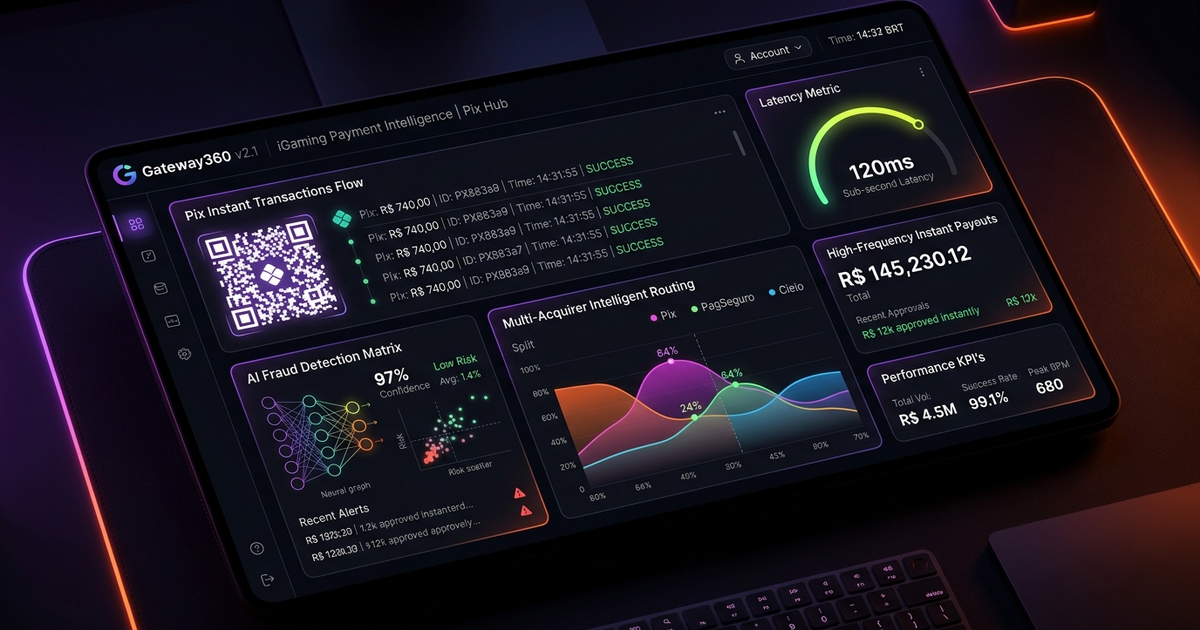
Licensed iGaming platforms, live sportsbooks, and high-concurrency digital marketplaces operate under an unforgiving financial truth: every second of checkout latency translates into abandoned sessions and lost Gross Gaming Revenue (GGR). Architecting a high-throughput White-Label Payment Gateway requires replacing blocking monolithic request loops with event-driven pipelines, multi-acquirer smart routing, strict distributed idempotency, and behavioral anti-fraud running at sub-second settlement speed.
Explore Better2Better's White-Label High-Volume Payment Gateway
Run your own branded payment orchestration layer featuring direct instant settlement rails, automated multi-BaaS failover, first-party account ownership enforcement, chargeback/MED defense telemetry, and native affiliate split accounting on an immutable double-entry ledger.
1. Why Synchronous Gateways Collapse Under Live Traffic Bursts
Unlike steady e-commerce checkouts, regulated sportsbooks and interactive entertainment platforms experience vertical traffic spikes compressed into 30-to-180-second windows — halftime breaks, live goal events, or synchronized tournament launches. Instant deposit QR requests and bank confirmation webhooks surge from tens to thousands of operations per second almost instantaneously.
Traditional gateways fail during these surges because they keep client HTTP threads and relational database row locks open while awaiting external banking APIs. As soon as an upstream clearing institution suffers even 900 ms of tail latency, connection pools saturate, queued confirmation webhooks time out or arrive out of order, and player wallet balances drift from underlying settlement bank statements.
Architectural Comparison: Legacy Aggregator vs. Better2Better White-Label Gateway
| Engineering Dimension | Legacy Monolithic Intermediary | Better2Better White-Label Architecture |
|---|---|---|
| Concurrency Model | Blocking synchronous HTTP threads holding SQL connection pools | Asynchronous event-driven pipeline over Kafka/NATS with stateless workers |
| Instant Settlement Connectivity | Single settlement bank dependency without automated fallback | Multi-BaaS orchestration with live P95 health-check circuit breakers |
| Idempotency & Webhooks | Duplicate credit risk under network retries or queue lag | Atomic UUID v4 idempotency locks in Redis Cluster + unique ledger constraints |
| Account Ownership & Fraud | Delayed manual payout reviews with static rules | Pre-settlement directory match (1st-party cash-out only) + graph velocity checks |
| Affiliate & Vendor Split | Error-prone D+1/D+30 spreadsheet reconciliation | Atomic double-entry split execution at the exact moment of settlement |
| Spike Resilience (Live Match Half-Time) | Connection pool exhaustion and HTTP 502/504 timeouts | Horizontal edge autoscaling sustaining P99 < 120 ms edge latency |
2. Event-Driven Messaging Pipelines and Strict Distributed Idempotency
Sustaining 10,000+ transactions per second without corrupting account balances demands strict decoupling between payment intent creation (Cash-In) and upstream clearing confirmation (Settlement):
- Edge API Validation: The ingress tier verifies HMAC/mTLS signatures, tenant rate quotas, and
X-Idempotency-Keyuniqueness in memory before emitting a payment intent event. - Asynchronous Provider Workers: Specialized worker pools maintain persistent warm mTLS HTTP/2 connections across multiple direct instant-payment participants.
- Atomic Settlement Lock: When an upstream clearing webhook arrives containing a unique transaction identifier (such as
endToEndId), workers acquire an atomic lock in Redis Cluster so duplicate bank callbacks never double-credit a balance. - Real-Time WebSocket Push: Player applications receive instant settlement confirmation over persistent WebSockets without hammering operator servers with polling requests.
Controlled backpressure ensures that if a downstream banking endpoint degrades, queued intents wait safely or re-route transparently without cascading failures into the core gaming platform.
3. Multi-BaaS Smart Routing and Automated Circuit Breakers
Routing 100% of transaction volume through a single settlement partner creates an unacceptable single point of failure. Planned maintenance windows, TLS certificate rotations, or clearing house bottlenecks can freeze cash flow mid-event. Better2Better's routing engine evaluates upstream health continuously:
- Real-Time Telemetry Scoring: Every clearing partner is scored dynamically using rolling 60-second success rates, P95 QR/invoice generation latency, and average webhook settlement delay.
- Automated Circuit Breaking: Whenever upstream HTTP 5xx errors or timeouts breach a safety threshold (e.g., 2.5% over a 30s window), the circuit opens immediately and routes 100% of new traffic to healthy secondary banks.
- Cost & Volume Weighting: Under nominal conditions, operators configure percentage weights (e.g., 65% Primary Bank with negotiated MDR, 35% Secondary Bank) while enforcing daily volume caps.
- Canonical Financial Normalization: Different bank payload schemas are normalized into a single internal event contract so operator ERPs and reconciliation dashboards remain provider-agnostic.
4. Sub-Second Payouts and First-Party Account Ownership Verification
Under strict regulatory frameworks, instant withdrawals (Cash-Out) represent the highest exposure to account takeover, mule rings, and compliance sanctions. A production-grade white-label gateway validates beneficiary ownership before funds leave the treasury account:
- Pre-Disbursement Directory Matching (1st-Party Only): Before releasing an instant payout, the engine queries the payment directory and strictly verifies that the receiving account tax ID matches the verified KYC holder on the operator's platform.
- Velocity, Geofencing & Mule Cluster Detection: Behavioral analytics correlate device fingerprints, IP/ASN anomalies, deposit-without-wagering turnover patterns (smurfing), and destination keys shared across unrelated player accounts.
- Risk-Tiered Automated Release Queues: Low-risk legitimate withdrawals clear in under 1.5 seconds, while flagged anomalies route cleanly to biometric step-up verification or compliance officer review.
5. Automated Evidence Dossiers for Fraud Dispute and MED Defense
Friendly fraud and abusive payment dispute claims — where malicious actors deposit, place wagers, lose, and subsequently claim unauthorized bank transfers — rapidly erode operator profitability unless backed by indisputable audit trails.
Better2Better's gateway automatically compiles an Immutable Transaction Evidence Dossier linking KYC verification status, IP/device telemetry at checkout time, exact tax-ID alignment between payer and player profile, cryptographic hashes of wagering sessions, and clearing timestamps. When a dispute notice arrives via banking APIs, operators export verified proof packages within seconds to protect escrow liquidity.
6. Technical Specification: Idempotent Webhook Contract & Atomic Split
Canonical Instant Settlement & Split Event Contract (JSON)
Every confirmed clearing callback is normalized into this immutable schema prior to ledger posting and HMAC-SHA256 webhook delivery:
{
  "eventId": "evt_01JCH9X4Q8M2B7V9W5K1P3R6T8",
  "eventType": "INSTANT_RAIL.CASHIN.SETTLED",
  "occurredAt": "2026-11-12T18:24:11.412Z",
  "idempotencyKey": "9b4d7c10-6f2a-4c3e-8a11-77e0f9b2c104",
  "settlement": {
    "endToEndId": "E0000000020261112182400129485712",
    "acquirerNode": "spi-partner-primary-01",
    "amountCents": 25000,
    "currency": "BRL",
    "payerTaxIdHash": "sha256:9f84b2c1...e03a",
    "kycTaxIdMatch": true
  },
  "splitEntries": [
    { "account": "operator_treasury_main", "role": "MERCHANT_NET", "amountCents": 23625 },
    { "account": "affiliate_network_tier1", "role": "AFFILIATE_REVSHARE", "amountCents": 1000 },
    { "account": "gateway_fee_reserve", "role": "GATEWAY_MDR", "amountCents": 375 }
  ],
  "signature": "hmac-sha256=4a91f78c62d0e3b5c1a9f004..."
}- endToEndId + idempotencyKey: Composite unique key enforced at the ledger database level and cached for 72 hours in Redis Cluster to guarantee zero duplicate balance updates.
- kycTaxIdMatch: Mandatory pre-credit boolean asserting strict tax-ID alignment between the originating bank account and verified customer KYC.
- splitEntries: Atomic array whose algebraic sum must equal
amountCents, generating balanced double-entry debit/credit rows in a single ACID commit. - signature: HMAC-SHA256 digest over raw body and
X-Webhook-Timestampto prevent spoofing and replay attacks.
7. Double-Entry Accounting Ledger and Real-Time Revenue Splitting
High-volume platforms juggling affiliate networks, game studio royalties, tax withholdings, and operator margins cannot safely update mutable floating-point balance columns. Every cleared transaction generates immutable records inside a Double-Entry Ledger where clearing suspense accounts, affiliate sub-ledgers, technology reserves, and net treasury balances sum cleanly to zero.
Automated intraday reconciliation compares settled banking API feeds and CNAB files against ledger totals every hour, isolating disputes, reversals, and fee discrepancies before end-of-day treasury closing.
Production SLA Targets and Engineering Benchmarks
| System Layer / Metric | Target Benchmark | Enforcement Mechanism |
|---|---|---|
| Dynamic Invoice / QR Issuance | P99 < 140 ms | Warm mTLS pools + distributed BaaS auth token caching |
| End-to-End Deposit Confirmation | < 1.8 s post-clearing | Async event consumers + direct WebSocket checkout push |
| Platform Uptime SLA | 99.99% Active-Active | Multi-AZ topology + automated multi-BaaS circuit breakers |
| Ledger Integrity | Zero Cent Drift (ACID) | Double-entry accounting with automated hourly T+0 reconciliation |
| Peak Burst Throughput | 12,000+ req/sec | Tenant-sharded messaging partitions + elastic worker pools |
8. Regulatory Compliance, Account Segregation, and Cryptographic Hardening
Regulated gaming and payment ecosystems mandate verifiable governance across fund custody, AML monitoring, and data security:
- Strict Patrimonial Account Segregation: Player balances, prize reserve pools, and corporate operating revenues reside in segregated banking and ledger accounts.
- Zero Trust & KMS/HSM Key Management: All mTLS client certificates and API signing secrets live inside hardware-backed KMS/Vault clusters with automated key rotation.
- Continuous AML/KYC Surveillance: Automated flagging of smurfing, structured deposits, mismatched payer identities, and anomalous turnover patterns with regulator-ready audit exports.
- WORM Audit Logging: Tamper-evident append-only audit logs preserving full checkout, clearing, payout, and split configuration history for 5+ years.
9. Production Readiness Checklist & SRE Go-Live Runbook
Verify every control below before routing live peak-event payment traffic:
[OK]Strict Idempotency Keys: Require X-Idempotency-Key across all Cash-In and Cash-Out endpoints backed by 72h Redis deduplication.[OK]Multi-BaaS Failover GameDay: Simulate primary bank outage and verify automated circuit breaker cutover completes in under 3 seconds.[OK]1st-Party Payout Locking: Enforce strict tax-ID matching against verified KYC records prior to releasing any withdrawal.[OK]HMAC-SHA256 Webhook Verification: Validate cryptographic callback signatures and timestamp windows across operator consumers with exponential backoff retries.[OK]Intraday Ledger Reconciliation: Run automated hourly parity checks matching bank settlement APIs with double-entry ledger sub-accounts.[OK]10x Spike Load Testing: Execute stress tests at 10x baseline concurrency confirming P99 < 150 ms with zero SQL lock contention.
10. Frequently Asked Questions on White-Label Payment Gateways (FAQ)
Why deploy a dedicated White-Label Gateway instead of relying on generic PSPs?
A dedicated white-label architecture removes single-PSP markups and throttling, gives you direct multi-bank failover during live traffic spikes, enforces custom anti-fraud rules, and automates multi-party affiliate splits inside your own ledger.
How does the architecture prevent duplicate deposits if a bank fires a webhook twice?
Each bank settlement carries a unique transaction identifier paired with our X-Idempotency-Key. Workers acquire a distributed Redis lock and enforce a unique database constraint on the ledger before crediting any wallet, returning an idempotent HTTP 200 to duplicate callbacks.
Can the gateway automatically block third-party mule payouts?
Yes. Before initiating any Cash-Out disbursement, the gateway validates beneficiary ownership directly against the instant-payment directory and rejects payouts whose tax ID mismatches the account's verified KYC identity.
How does the platform protect operators against abusive payment disputes?
Every cleared deposit builds an automated forensic package linking biometric KYC approval, checkout IP/device telemetry, payer tax-ID verification, and gameplay session hashes for rapid regulatory and bank contestation.
Does the platform support real-time affiliate and partner revenue splits?
Yes. At the moment of Cash-In settlement or configurable clearing cycles, the double-entry ledger partitions gross volume across merchant treasury, affiliate sub-accounts, and platform fee reserves atomically.
How fast can a Better2Better White-Label Gateway be launched?
Dedicated white-label environments with OpenAPI 3.1 specifications, SDKs, and Sandbox endpoints are provisioned in days, enabling smooth certification with your licensed settlement bank partners.
Is the system engineered for strict gaming and central bank compliance?
Yes. Fund segregation, immutable WORM audit logs, real-time AML alerts, and zero-trust cryptographic key management are built natively into the core platform.
Architect or scale this infrastructure in your operation
Speak directly with Better2Better principal systems architects to assess scale capacity, security requirements, integrations, and deployment timelines for your business.