
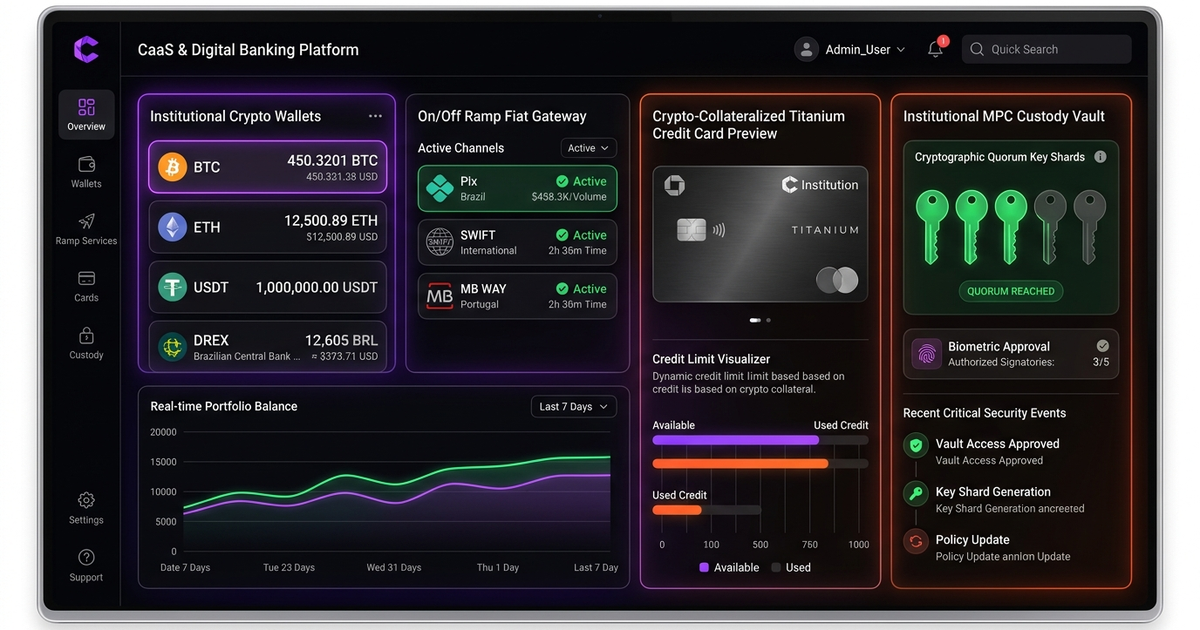
Building proprietary digital asset infrastructure from scratch demands 18 to 24 months of cryptography engineering, market-maker integrations, and complex VASP licensing across jurisdictions. Crypto-as-a-Service (CaaS) abstracts institutional MPC custody, multi-venue liquidity aggregation, traditional banking rails (SWIFT, Pix, MB WAY), and continuous compliance into turnkey enterprise APIs.
Discover Better2Better's Global Crypto as a Service (CaaS) Architecture
Power your platform with segregated MPC custody, smart order routing, regulated settlement orchestration, and native SWIFT, Pix, MB WAY, Mercado Pago & PayPal rails via clean REST/WebSocket APIs.
1. Defining Crypto-as-a-Service (CaaS) in Institutional Finance
Crypto-as-a-Service (CaaS) provides a modular B2B API suite enabling fintechs, payment processors, ERPs, and global enterprises to embed buying, selling, stablecoin treasury settlement (USDC/USDT), MPC custody, and crypto-collateralized cards natively inside existing applications without holding standalone VASP licenses or running blockchain nodes.
Strategic Comparison: In-House Build vs. Enterprise CaaS Infrastructure
| Architecture Pillar | In-House Custom Engineering | Better2Better CaaS Platform |
|---|---|---|
| Time-to-Market | 18–24 months with specialized HSM/Web3 staff | Full API & Sandbox launch in under 15 days |
| Private Key Security | High-risk custom vault management & insurance | Institutional MPC-TSS + FIPS 140-2 Level 3 HSMs |
| Execution Liquidity | Shallow single-exchange order books & slippage | Smart Order Routing across OTC desks, CEXs & DEX pools |
| On-Chain Compliance | Separate blockchain analytics & sanctions vendors | Built-in real-time KYT + Travel Rule (IVMS101 / TRISA) |
| Global Fiat On/Off-Ramps | Manual multi-country FX and bank onboarding | Regulated clearing network with SWIFT, Pix & MB WAY |
2. Multi-Party Computation (MPC-TSS) Custody Without Single Points of Failure
Eliminating complete private keys at rest or in memory guarantees resilience against insider collusion or server breaches:
- Distributed Key Shares: Cryptographic shards remain isolated inside hardware security enclaves across independent nodes and governance signers.
- Threshold Signing: Authorized m-of-n quorums compute valid blockchain signatures collaboratively without ever reconstructing a single master key.
- Programmable Governance Policies: Granular withdrawal velocity limits, cold-storage address allowlists, and executive multi-approval rules.
3. Multi-Venue Smart Order Routing (SOR) and Guaranteed RFQ Quotes
Corporate treasuries and retail fintech apps demand tight spreads and predictable execution prices:
- Aggregated Order-Book Depth: Continuous price discovery over WebSocket/FIX across regulated OTC desks and tier-1 liquidity pools.
- Deterministic Quote Locks: Firm RFQ pricing held across configurable clearing windows eliminating slippage during checkout.
- Intelligent Order Slicing: Large block orders split across venues to minimize market impact.
4. Sub-Second Off-Chain Ledgers Paired with Multi-Chain Settlement
Posting every internal user movement on congested L1 blockchains kills UX with gas fees. Combining a double-entry off-chain ledger (< 25 ms internal transfers) with automated multi-chain routing (Bitcoin, Ethereum, Solana, Polygon, Arbitrum, Base, Tron) optimizes both cost and blockchain reorg safety.
5. Bridging Global Banking Rails and E-Commerce Ecosystems
Native connectivity across SWIFT GPI, Pix (Brazil), MB WAY (Europe), Mercado Pago, and PayPal lets platforms collect fiat locally and settle instantly in audited stablecoins or local currencies through regulated partners.
6. Technical Specification: Locked RFQ On-Ramp Settlement Order (JSON)
Idempotent CaaS On-Ramp Order with Locked FX Rate (JSON)
Executed by wallets, ERPs, and payment gateways to lock deterministic pricing across fiat and on-chain rails:
{
  "idempotencyKey": "caas-rfq-901a7c4b-11ef-428d-9c2a-0192b4001122",
  "tenantId": "ent_corp_treasury_08",
  "operation": "FIAT_TO_CRYPTO_SETTLE",
  "source": { "rail": "SWIFT_GPI", "currency": "USD", "amount": "50000.00" },
  "destination": { "asset": "USDC", "network": "SOLANA", "custodyVaultId": "mpc_vault_main_01" },
  "quote": {
    "quoteId": "qt_8820194b",
    "lockedRate": "1.0002",
    "expiresAt": "2026-11-12T18:45:10Z"
  },
  "compliance": { "kytScreening": "MANDATORY", "travelRuleVaspId": "vasp_b2b_intl_01" }
}- quoteId + expiresAt: Protects against market volatility while upstream fiat settlement clears within the agreed TTL.
- custodyVaultId: Routes cleared assets directly into segregated tenant MPC vaults.
- travelRuleVaspId: Attaches encrypted IVMS101 counterparty identity payloads for regulated VASP transfers.
7. Real-Time KYT Screening, Sanctions Enforcement, and Travel Rule
Continuous Know Your Transaction (KYT) checks inspect incoming and outgoing on-chain hashes against OFAC sanctions, mixers, and illicit heuristics before ledger credit, paired seamlessly with encrypted TRISA/IVMS101 Travel Rule messaging.
Enterprise Use Cases & Quantifiable Operational Impact
| Industry Vertical | Core CaaS Capability | Measurable Outcome |
|---|---|---|
| Global B2B Payroll & Treasury | Instant cross-border USDC supplier payouts | 60%–80% FX reduction and D+0 finality vs D+3 SWIFT |
| Fintechs & Neobanks | In-app crypto trading + collateral credit line | New fee revenue and higher user retention without balance-sheet exposure |
| Global E-Commerce | Accept crypto globally with instant fiat payout | Zero treasury volatility or manual crypto tax bookkeeping |
8. Full White-Label Experience and Regulated Clearing Governance
End users interact solely with your brand's UI, domain, and card designs while regulated clearing institutions handle statutory FX closure and safeguarding compliance.
9. Production Launch & SRE Checklist for CaaS Integrations
Confirm every safeguard prior to going live with real customer volume:
[OK]MPC Quorum Disaster Recovery Tested: Verify recovery key share procedures without exposing unified key material.[OK]RFQ Quote Expiration Handling: Test expired payment receipt handling and automatic refund/requote workflows.[OK]Pre-Credit KYT Quarantine Validation: Simulate sanctioned deposit hashes confirming instant hold before available balance credit.[OK]Idempotent HMAC Webhook Consumers: Validate deduplication of asynchronous settlement and compliance alerts.[OK]Double-Entry Fee & Spread Parity: Verify margin splitting across platform revenue and regulated liquidity accounts.
10. Frequently Asked Questions on Crypto-as-a-Service (CaaS) (FAQ)
Do we need our own crypto/VASP license to integrate CaaS?
No. Better2Better connects your product to regulated settlement partners and compliant custody rails so you deploy legally in weeks rather than years.
Does accepting crypto payments expose our company to price volatility?
No. Instant RFQ rate locking converts crypto inflows immediately into USD, EUR, BRL, or audited stablecoins inside segregated treasury accounts.
How are customer private keys protected?
Enterprise MPC-TSS cryptography backed by FIPS 140-2 Level 3 HSMs prevents private keys from ever assembling in a single location.
How does a CaaS platform differ from integrating a retail crypto exchange?
Retail exchanges lack tenant-isolated white-label custody, multi-rail fiat settlement (SWIFT, Pix, MB WAY), embedded Travel Rule APIs, and card-issuing collateral engines.
Which blockchains are supported natively?
Bitcoin, Ethereum, Solana, Polygon, Arbitrum, Base, Tron, and regulated stablecoins including USDC and USDT.
How quickly can our engineering team start testing?
Sandbox credentials, OpenAPI 3.1 docs, and multi-language SDKs provision in under 24 hours after initial technical kickoff.
Architect or scale this infrastructure in your operation
Speak directly with Better2Better principal systems architects to assess scale capacity, security requirements, integrations, and deployment timelines for your business.