
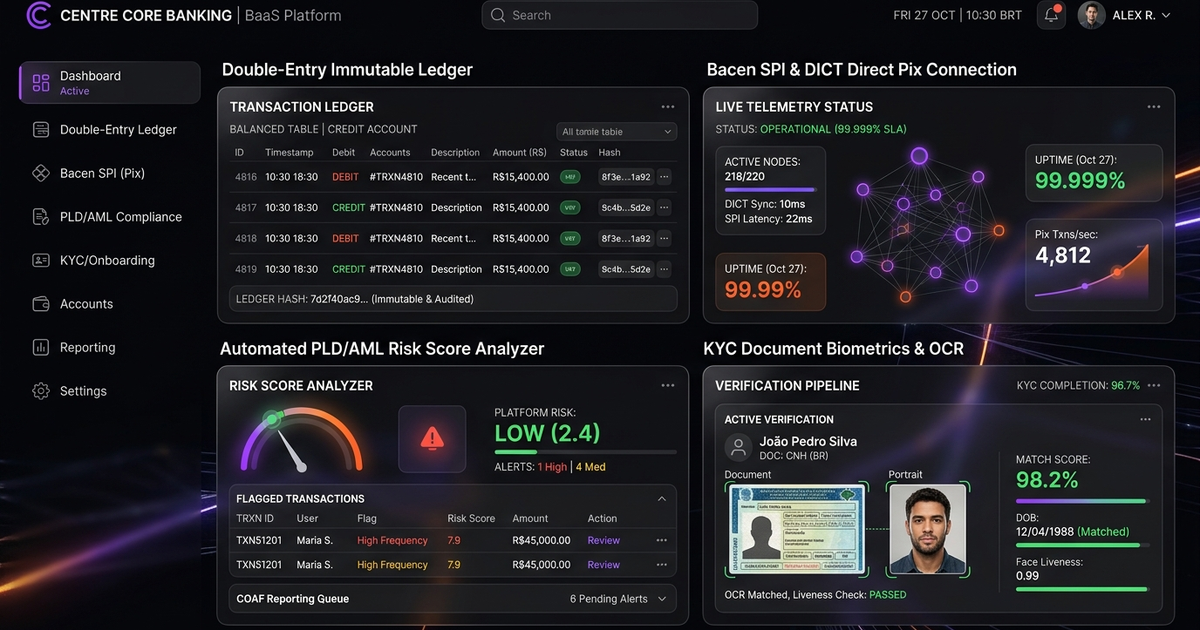
Legacy compliance engines built around static threshold rules drown risk operations teams in over 95% false-positive alert queues while failing to catch coordinated smurfing rings and mule networks. A next-generation AML Architecture unifies real-time graph analytics, perpetual KYC (pKYC), and inline behavioral scoring to stop illicit flows prior to settlement while automating regulatory filing workflows.
Discover Better2Better's Core Banking & Graph AML Compliance Platform
Embed real-time multi-hop graph link detection, perpetual KYC, unified fiat/on-chain KYT surveillance, global sanctions screening, and audit-ready SAR dossier automation natively inside your fintech or exchange.
1. Why Static Threshold Rules Fail Against Modern Money Laundering Networks
Coordinated illicit rings intentionally evade fixed reporting ceilings through smurfing, recruited money-mule accounts, rapid device rotation, and multi-hop layering across instant fiat payment rails and stablecoin bridges. Evaluating individual transfers inside isolated relational tables leaves systemic collusion completely invisible — and batch overnight processing alerts teams long after irreversible funds depart.
Technology Comparison: Static Legacy Rules vs. Better2Better Graph AML Engine
| Compliance Capability | Legacy Batch Engine (D+1) | Better2Better Real-Time Graph & AI |
|---|---|---|
| Hidden Ring Detection | Slow relational JOINs capped at 1-hop visibility | Native 4-to-6-hop graph traversal in < 25 ms |
| Intervention Window | Post-settlement overnight alert batches after funds exit | Inline pre-settlement blocking across instant rails & crypto payouts |
| False-Positive Burden | 85%–96% noisy alerts consuming analyst capacity | 65%+ alert fatigue reduction via peer-group behavioral scoring |
| Customer Due Diligence | Static onboarding snapshots refreshed yearly | Perpetual KYC (pKYC) triggered dynamically by income/device anomalies |
| Regulatory Filing (SAR) | Manual evidence compilation across siloed logs | One-click audit-ready SAR dossier with immutable WORM trails |
2. Real-Time Graph Intelligence: Exposing Mule Clusters in Milliseconds
Modeling customers, tax IDs, devices, IP subnets, destination bank keys, and blockchain addresses inside a low-latency graph store exposes structural anomalies instantly:
- Fan-In / Fan-Out Layering Detection: Flags dispersed small inbound deposits funneling rapidly into consolidated cash-out beneficiaries or external wallets.
- Device & Network Contagion: Propagates risk automatically across connected customer subgraphs whenever distinct accounts share hardware fingerprints or coordinated ASN nodes.
- Unified Fiat + On-Chain KYT Graph: Connects multi-chain stablecoin provenance with local banking velocity to detect obfuscation before payout release.
3. Perpetual KYC (pKYC) and Dynamic Risk-Based Tiering
Global FATF guidelines require ongoing risk assessment rather than static point-in-time onboarding verification:
- Continuous Watchlist & PEP Sync: Real-time screening across OFAC, UN, EU sanctions lists, PEP registries, and adverse media updates.
- Financial Capacity Parity: Rolling comparison between declared corporate revenue/income and real-time transactional velocity.
- Automated EDD Escalation: Abrupt ownership shifts or behavioral drift elevate customer tiers cleanly into Enhanced Due Diligence.
4. Inline Pre-Settlement Scoring Without Breaking Instant UX
A dual-lane streaming architecture balances strict latency guarantees with deep machine learning inference:
- Inline Fast-Path (< 35 ms): Evaluates pre-computed graph features and deterministic sanctions/mule rules inside the synchronous payout authorization path.
- Async Deep-Path Streaming: Runs Graph Neural Networks (GNN) and Gradient Boosted Trees across full historical sequences to refresh risk embeddings continuously.
5. Explainable Case Management and Automated Regulatory Dossiers
Regulators reject opaque black-box scores. Every raised alert must preserve clear evidentiary attribution:
- SHAP Feature Attribution: Explains the exact drivers triggering an alert (e.g., '2 hops from flagged mule + 6.8x declared monthly volume ratio').
- Integrated Evidence Collaboration: Interactive subgraph timelines, structured Source-of-Funds requests, and one-click WORM-archived SAR/regulatory filing exports.
6. Technical Specification: Inline Graph Scoring & Decision Contract
Synchronous AML Graph Evaluation Contract (JSON)
Consulted by Core Banking or Payment Gateway workers in under 35 ms prior to payout clearing:
{
  "evaluationId": "aml_01JCHC4W9X2K8P1M5N3R7V0Y6B",
  "transactionRef": "payout_9948102",
  "actor": {
    "customerId": "cus_771204",
    "riskTier": "MEDIUM_HIGH",
    "pepMatch": false,
    "declaredMonthlyIncomeCents": 1200000
  },
  "graphSignals": {
    "sharedDeviceClusterSize": 4,
    "shortestHopsToFlaggedMule": 2,
    "rolling24hFanInCount": 31,
    "rolling30dVolumeRatio": 6.8
  },
  "scoring": {
    "inlineRiskScore": 0.91,
    "decision": "HOLD_STEP_UP_REVIEW",
    "triggeredPolicies": ["ATIPICAL_VOLUME_RATIO", "GRAPH_MULE_PROXIMITY_2HOP"],
    "latencyMs": 19.4
  }
}- shortestHopsToFlaggedMule: Pre-indexed graph distance linking the counterparty cleanly to previously sanctioned or disputed accounts.
- rolling30dVolumeRatio: Dynamic ratio comparing 30-day cumulative volume against verified financial profile.
- decision: Returns deterministic disposition (
ALLOW,STEP_UP_BIOMETRIC,HOLD_STEP_UP_REVIEW, orBLOCK).
7. Streaming Feature Engineering and Reproducible Compliance Audits
Hot window aggregates cached inside Kafka Streams and Redis feed the inline graph engine while locking exact rule-set and ML model versions onto every transaction record for multi-year regulatory replay.
Global Regulatory Coverage Matrix
| Framework / Standard | Core Mandate | Native Better2Better Enforcement |
|---|---|---|
| FATF / GAFI Risk-Based Approach | Continuous customer & transaction risk monitoring | Dynamic pKYC scoring + automated EDD tier triggers |
| OFAC / UN / EU Sanctions | Zero-tolerance sanctioned entity blocking | Inline sub-15 ms fuzzy name & wallet address screening |
| Travel Rule (IVMS101 / TRISA) | VASP originator & beneficiary payload exchange | Encrypted VASP-to-VASP identity exchange prior to settlement |
| FinCEN / COAF SAR Filing | Timely suspicious activity reporting & audit logs | Versioned policy history + automated WORM case dossiers |
8. Model Governance, Privacy Safeguards, and WORM Retention
Strict role-based access control (RBAC), periodic statistical drift backtesting, human-in-the-loop SAR sign-off, and tamper-evident WORM repositories preserve data privacy alongside mandatory multi-year statutory retention.
9. Production Launch & SRE Compliance Checklist
Confirm each control before activating automated transaction holds:
[OK]Shadow Mode Calibration: Run scoring rules in shadow mode across 14 days to benchmark precision before enforcing inline blocks.[OK]Fast-Path Latency Budget < 40 ms: Validate timeout fallback behavior ensuring instant rails never stall unpredictably.[OK]Automated Watchlist Sync Checks: Monitor daily hash verification of OFAC, UN, and PEP database updates.[OK]Immutable Version Tagging: Verify every decision persists rule-version and model-version identifiers.[OK]WORM Evidence Archiving: Confirm append-only preservation of case files and compliance analyst sign-offs.
10. Frequently Asked Questions on Graph AML & Compliance (FAQ)
How does graph analytics outperform conventional AML rules?
Static rules inspect isolated transactions and produce high false positives, whereas graph engines uncover multi-hop mule networks, fan-in/fan-out laundering rings, and shared device clusters in milliseconds.
Does inline AML scoring slow down instant payments?
No. Pre-computed graph signals and deterministic rules execute within 35 ms P99, preserving sub-second clearing speed.
Can one compliance engine monitor both fiat and crypto CaaS flows?
Yes. Fiat transfers, instant rails, and on-chain KYT/Travel Rule telemetry feed a unified customer risk graph.
How do analysts explain alerts during regulatory exams?
Every alert records SHAP feature attribution, policy versions, and interactive graph lineage for transparent audit justification.
How fast can an existing fintech integrate this engine?
Via synchronous REST pre-settlement checks and Kafka/webhook event streams, shadow-mode deployment typically begins within days.
Does automated scoring replace human compliance officers?
No. It automates noisy triage and emergency preventive holds so compliance teams devote time to genuine high-risk investigations and statutory filings.
Architect or scale this infrastructure in your operation
Speak directly with Better2Better principal systems architects to assess scale capacity, security requirements, integrations, and deployment timelines for your business.