
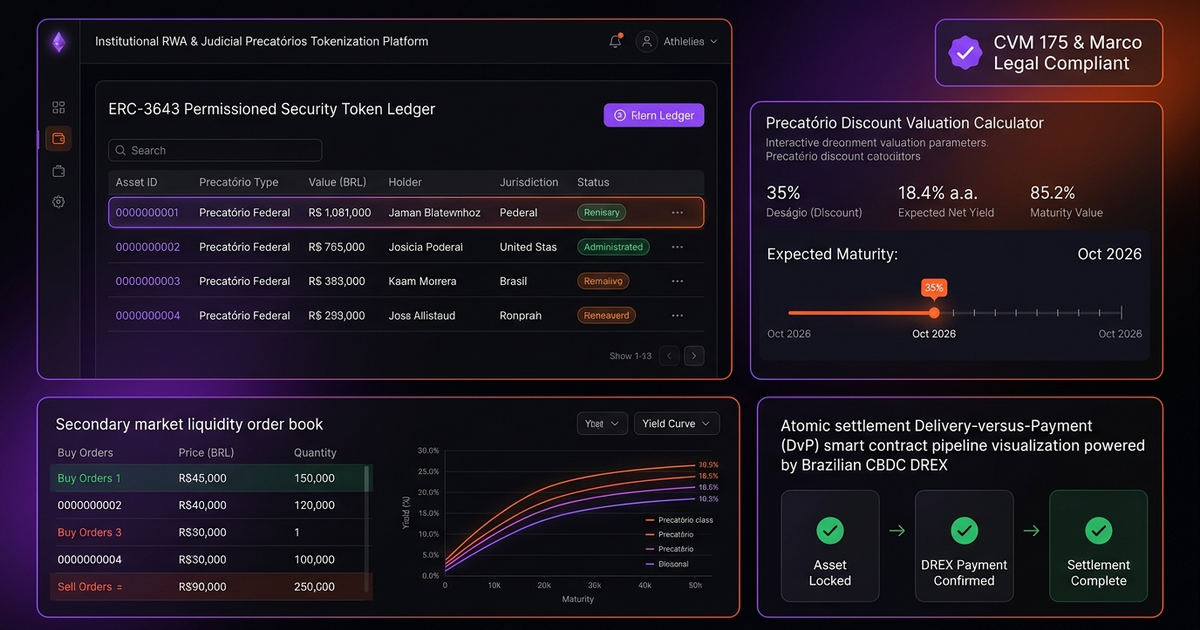
Finalized government court judgments and statutory municipal/sovereign claims represent tens of billions in enforceable fixed-income receivables worldwide, yet remain locked behind severe illiquidity, multi-layered broker opacity, and punitive OTC haircuts ranging from 35% to 55% of face value. This institutional guide breaks down how to engineer a compliant court claim RWA tokenization platform uniting bankruptcy-remote SPV / trust ring-fencing, actuarial IRR and discount-curve modeling, judicial docket oracles, and ERC-3643 DvP settlement.
Launch Your Regulated Court Claims & RWA Tokenization Platform with Better2Better
Deploy turnkey white-label infrastructure covering regulated ERC-3643 issuance, automated KYC/AML compliance, claim pricing engines, judicial monitoring feeds, and instant escrow dividend settlement.
1. The Structural Illiquidity Trap of Enforced Public Receivables
Even after winning an unappealable final court judgment against a sovereign treasury or public agency, original plaintiffs frequently wait two to seven years for statutory budget appropriation and cash release. Selling claims bilaterally in opaque secondary markets forces creditors to surrender massive value across middlemen while depriving fixed-income investors of high-yield, low-correlation sovereign exposure.
Converting rigorously vetted judicial claims into compliant tokenized RWAs replaces fragmented phone-broker deals with fractional digital securities carrying auditable cash-flow priority and institutional custody safeguards.
Structural Comparison: Legacy OTC Judgment Brokerage vs. Tokenized RWA Platform
| Operational & Risk Dimension | Traditional Bilateral OTC Broker | Better2Better Tokenized RWA Stack (SPV + ERC-3643) |
|---|---|---|
| Minimum Purchase Size | Whole single-docket buyouts ($50K to $5M+) | Regulated fractional notes accessible from $1,000 |
| Haircut & Fee Transparency | Stacked opaque brokerage spreads eating 10%–20% upside | Transparent actuarial yield curve net of statutory interest & fees |
| Double-Assignment Protection | Risk of seller transferring claims twice prior to court docket filing | Public deed assignment filed in court record + immutable cap-table lock |
| Court Docket Visibility | Manual periodic queries by outside counsel | Automated docket oracles indexing judicial filings and budget inclusion |
| Pre-Maturity Liquidity | Zero liquidity until treasury payout disbursement | Permissioned OTC secondary board among KYC-whitelisted investors |
| Payout & Tax Accounting | Manual spreadsheets upon final settlement years later | Real-time dashboard, escrow reconciliation, and automated tax withholding logs |
2. Judicial Due Diligence Pipeline and Legal Risk Filtering
No two litigation claims share identical legal risk. A disciplined RWA origination engine mandates strict automated and legal screening before approving mint authorization:
- Finality (Res Judicata) Verification: Confirms exhaustion of all appeals and statutory challenge windows before valuing face principal.
- Actuarial Calculation & Interest Audit: Validates exact court-approved statutory indexation schedules without contested computation challenges.
- Encumbrance, Tax Lien & Prior Assignment Screening: Audits seller tax, labor, and civil dockets plus court records to defeat fraudulent conveyance or conflicting-assignment clawbacks.
- Counsel Fee Carve-Out Isolation: Legally separates attorney contingency and statutory fees in the notarized assignment deed so tokenized tranches reflect 100% net principal ownership.
3. Ring-Fenced Legal Structure: Notarized Assignment, SPV Isolation, and ERC-3643
Protecting fractional holders from platform insolvency requires strict legal asset segregation:
- Public Deed Assignment & Docket Substitution: The seller executes an irrevocable assignment filed formally inside the issuing court docket alongside verified beneficiary substitution.
- Bankruptcy-Remote SPV / Trust Ring-Fencing: Under applicable securities frameworks (e.g., Reg D/S, EU ELTIF, or Brazil RCVM 88/175), the claim sits inside an isolated trust account dedicated solely to that token series.
- Permissioned ERC-3643 Token Enforcement: Smart contract transfers programmatically enforce ONCHAINID KYC/AML approval and holding limits at execution time.
4. Quantitative Haircut Modeling, Interest Accrual, and Stress Testing
Institutional return combines upfront purchase discount with continuous statutory benchmark accrual until court deposit. Every issuance publishes baseline and stressed yield projections modeling +12 and +24 month fiscal delays alongside exact net-of-tax cash flow waterfalls so investors underwrite real duration-adjusted returns rather than misleading nominal face yields.
Actuarial Pricing Tiers & Debtor Sovereign Risk Profiles
| Judicial Claim Tier | Credit Profile & Duration | Statutory Indexation | Haircut & Target Net IRR Structure |
|---|---|---|---|
| Sovereign Priority Claim (Budget Included) | Highest sovereign credit quality; 12–18m payout window | Policy rate / sovereign benchmark compounding | Tighter haircut (12%–20%); low duration volatility |
| Sovereign General Claim (Scheduled Budget) | Sovereign credit quality; annual budget queue | Statutory post-judgment compounding rate | Moderate haircut (18%–28%); strong risk-adjusted IRR |
| Small-Value Fast-Track Claim (RPV) | 60 to 120 day court treasury disbursement cycle | Court pro-rata accrual schedule | Rapid capital velocity annualized fixed yield |
| Subnational Adherent Entity | Dependent on regional treasury cash flow | Inflation index + statutory coupon | 25%–42% discount absorbing modest fiscal delay buffers |
| Distressed Subnational Special Queue | Extended multi-year repayment installment plan | Probabilistic regional payout curve modeling | Deep 40%–55%+ discount paired with +24m stress scenario |
5. Automated Judicial Docket Oracles and Real-Time Telemetry
Institutional capital cannot depend on ad-hoc lawyer emails to monitor case progress. Our Judicial Docket Oracle polls official court registries and electronic gazettes, anchoring signed hashes of budget-inclusion orders, payment writs, or challenge motions directly to token metadata and alerting investors instantaneously on state transitions.
6. Technical Specification: Canonical Court Claim & Settlement Contract
Canonical Court Claim Valuation, Docket Proof & Settlement Contract (JSON)
Binding verified docket hashes, stress-tested IRR pricing metrics, and escrow payout rules inside one canonical JSON specification ensures transparent parity between court filings and on-chain tokens:
{
  "rwaStandard": "ERC3643_JUDICIAL_CLAIM_V2",
  "issuanceVehicle": "SPV_JUDICIAL_SERIES_2026_09",
  "judicialDossier": {
    "docketNumber": "0048192-44.2019.4.01.3400",
    "writReference": "PRC-FED-2025-884102",
    "debtorEntity": "FEDERAL_TREASURY",
    "priorityClass": "PRIORITY_STATUTORY",
    "finalJudgmentDate": "2024-03-18",
    "publicDeedRegistryHash": "0x72c18a904f22e819bc31047d9a188e52b0014ca9"
  },
  "valuationModel": {
    "updatedFaceValueUsd": "1000000.00",
    "acquisitionDiscountPct": "26.50%",
    "netAcquisitionCostUsd": "735000.00",
    "indexationBenchmark": "SOVEREIGN_STATUTORY_BENCHMARK",
    "expectedSettlementWindow": "2027-Q3",
    "projectedBaseNetIrrPct": "24.85%",
    "stressPlus24mIrrPct": "19.40%"
  },
  "liquidationWaterfall": {
    "courtEscrowDepositConfirmed": false,
    "taxWithholdingModel": "STATUTORY_SOURCE_RETENTION",
    "payoutRail": "INSTANT_BANK_WIRE_ON_WRIT",
    "autoBurnTokensOnFullPayout": true
  }
}- docketNumber & publicDeedRegistryHash: Mathematically anchors digital fractions to official court docket identifiers and notarized assignment deeds.
- projectedBaseNetIrrPct vs stressPlus24mIrrPct: Communicates base yield expectations transparently against delayed budget scenarios.
- payoutRail & taxWithholdingModel: Automates post-writ waterfall execution and net tax accounting upon deposit clearance.
- autoBurnTokensOnFullPayout: Guarantees complete token retirement upon full pro-rata principal and yield distribution.
7. Court Escrow Disbursement, Automated Waterfalls, and Token Burn
Once the sovereign debtor funds the court registry account, the payment writ settles directly into the issuance's segregated fiduciary bank escrow. BaaS webhooks trigger automated tax retention, contractual fee settlement, pro-rata payout across the verified cap table via instant bank transfer or stablecoins, and irreversible on-chain burn() closing the lifecycle.
8. Permissioned Secondary Marketplaces for Early Exit Liquidity
Tokenized fractions eliminate multi-year lock-up traps by enabling KYC-verified holders to sell positions prior to court disbursement on a permissioned secondary OTC bulletin board with atomic Delivery-versus-Payment (DvP) settlement priced continuously on remaining duration to payout.
9. Production SRE, Legal & Compliance Checklist for Court Claim Tokenization
Validate every legal, technical, and custodial safeguard before opening subscriptions:
[OK]Res Judicata & Appeal Expiry Verification: Archive certified non-appealable judgment extracts prior to underwriting valuation.[OK]Court Docket Substitution Filing Receipt: Verify public assignment registration inside court records before releasing seller settlement funds.[OK]Seller Lien & Fraudulent-Conveyance Clearances: Hash tax, labor, and civil clearance certificates stamped synchronously with deed execution.[OK]ERC-3643 & Escrow Isolation Audit: Test wallet KYC blocks and confirm fiduciary collection escrow prevents unauthorized withdrawals.[OK]Live Court Oracle Alert Verification: Confirm automated extraction of docket events and gazette publications propagates reliably to investor dashboards.
10. Frequently Asked Questions on Court Judgment Tokenization (FAQ)
Is tokenizing finalized court claims legally compliant?
Yes, when structured through bankruptcy-remote SPVs or regulated funds paired with notarized assignments and ERC-3643 compliance gates under local securities regulations.
How do you eliminate the risk of a claimant selling the same judgment twice?
Through notarized public assignment deeds, court-docket filing confirmation, comprehensive lien checks, and escrow holdbacks prior to seller payout release.
Why do distressed judicial claims offer significantly higher yields than government bonds?
Initial liquidity haircuts (15%–45%) combined with continuous statutory benchmark compounding deliver superior annualized IRRs once fractionalized efficiently.
What determines the payout timeline for a tokenized claim?
Statutory budget appropriation cycles and debtor tier (fast-track small claims vs. annual federal budget allocations or subnational queues).
How do token holders track ongoing court developments?
Automated Judicial Docket Oracles ingest official court filings and treasury budget notices in real time with verifiable hashes attached to token records.
Can investors exit before the government completes payment?
Yes. ERC-3643 permissioned secondary transfers enable KYC-verified buyers and sellers to settle fractional claims atomically via DvP.
How quickly can an enterprise launch a judicial RWA platform with Better2Better?
Our white-label RWA suite ships ready-to-brand with KYC onboarding, pricing simulators, escrow webhooks, and ERC-3643 smart contracts in weeks.
Architect or scale this infrastructure in your operation
Speak directly with Better2Better principal systems architects to assess scale capacity, security requirements, integrations, and deployment timelines for your business.