
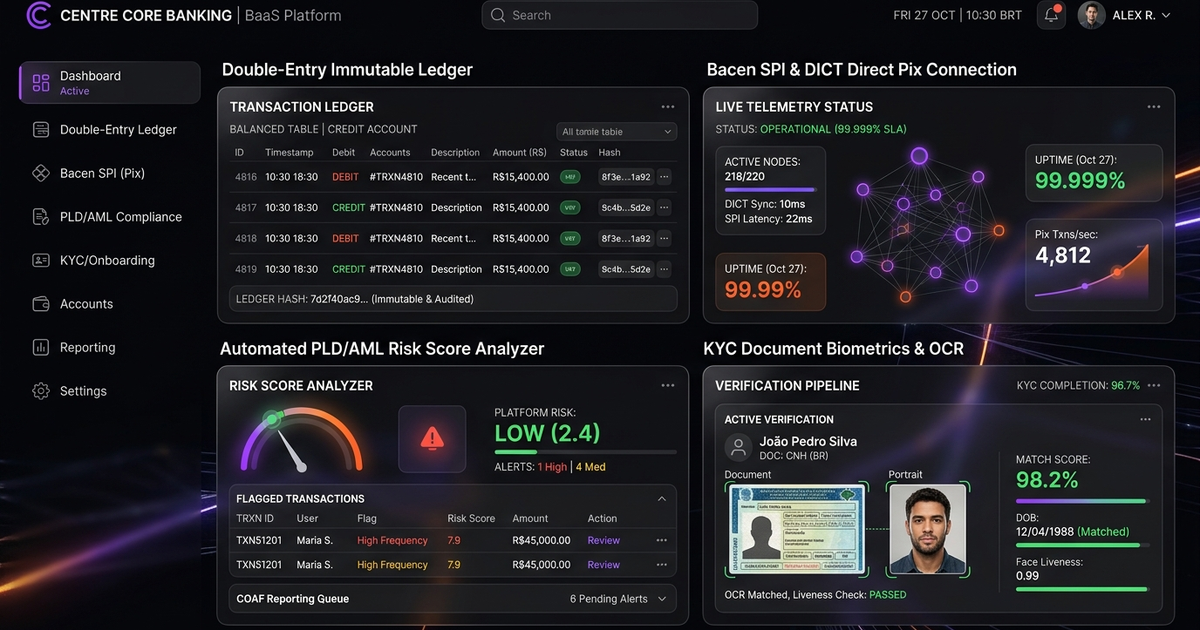
Launching a commercial neobank or Banking as a Service (BaaS) platform takes far more than a sleek mobile frontend. At the financial core lies an immutable double-entry Core Banking ledger — the systems layer engineered to account for every cent across segregated accounts, clear instant payments deterministically, and authorize ISO 8583 card frames in milliseconds without race conditions.
Discover Better2Better's Turnkey Core Banking & BaaS Platform
Deploy your branded neobank or BaaS operation with an immutable double-entry ledger, direct instant rail connectivity, Visa/Mastercard card issuance, escrow sub-accounts, and automated T+0 reconciliation with built-in regulatory auditability.
1. The Fatal Flaw of Mutable Balance Columns and Double-Entry Sovereignty
Early-stage fintech teams routinely model customer wallets as mutable fields incremented or decremented in place. Under concurrent instant transfers, simultaneous card swipes, and fee postings, read-modify-write contention produces race conditions, database deadlocks, and irreconcilable ledger drift.
Institutional Core Banking engineering prohibits overwriting balances. Every account balance derives strictly from an append-only stream of balanced double-entry journal postings where every debit is paired with an equal and opposite credit, enforcing zero-sum mathematical integrity across the entire bank.
Engineering Comparison: Naive Mutable Balance vs. Better2Better Core Banking
| System Layer | Naive Mutable SQL Column | Better2Better Double-Entry Core Banking |
|---|---|---|
| Accounting Model | Overwriteable numeric `balance` column | Append-only double-entry journal ledger (Debits + Credits = 0) |
| Concurrent Load Safety | SQL row lock deadlocks and phantom balance drift | Two-Phase Holds + serialized account state transitions |
| Instant Payment Clearing | Blocking queues risking double payout on timeout | Deterministic idempotency keys + finite state machine transitions |
| Card Issuing Authorization | Batch D+1 sync vulnerable to negative overdraft | Real-time ISO 8583 switch tightly coupled to holds (< 65 ms) |
| Regulatory Audit Trail | Cannot reconstruct exact point-in-time historical balances | Deterministic millisecond balance replay across full audit history |
2. Two-Phase Balance Reservations (Authorization Holds & Settlement)
Real-world payments span multiple asynchronous stages: card authorizations clear days later via settlement files, and instant bank payouts sit in flight until confirmed by central clearing houses. A deterministic state machine separates available from encumbered funds:
- Phase 1 — Encumbered Hold: Upon receiving a payout request or ISO 8583 authorization frame, the ledger atomically shifts funds from the customer's
AVAILABLEsub-account into anENCUMBEREDhold account. - Phase 2 — Settlement or Release: Once final clearing arrives, funds settle out of
ENCUMBEREDagainst external clearing suspense accounts; upon cancellation or expiry, a clean reversal restores availability with full audit lineage. - Double-Spend Elimination: Spending limits inspect exclusively unencumbered sub-account balances, guaranteeing parallel requests cannot double-spend the same dollar.
3. Direct Instant Rail Orchestration and Segregated Escrow Accounts
Enterprise digital banks require deep programmatic control over domestic and international clearing rails alongside BaaS partner sub-accounts:
- Real-Time Alias & Directory Routing: Automated lookup and validation across instant payment directories (Pix/DICT, FedNow, SEPA Instant) prior to committing transfers.
- Idempotent ISO 20022 Messaging: Cryptographically signed instant clearing messages with sub-2-second settlement confirmation and strict end-to-end transaction deduplication.
- Programmable Escrow Sub-Ledgers: Ring-fenced custody accounts enforcing conditional releases for lending platforms, marketplaces, and regulated trust structures.
4. Card Issuing Switch and Real-Time Ledger Coupling
Connecting digital checking accounts directly to Visa and Mastercard rails demands tight latency budgets between card scheme switches and ledger holds:
- Sub-65ms ISO 8583 Authorization Switch: Evaluates available balances, merchant category code (MCC) rules, velocity caps, and geofencing before responding to terminal requests.
- Instant Virtual Cards & Digital Wallets: Programmatic issuance of Apple Pay / Google Pay tokenized corporate expense and consumer cards with dynamic spend controls.
- Unified Debit, Credit & Collateral Lines: Seamless ledger tracking across checking deposits, revolving credit limits, and asset-backed spending lines.
5. Automated Daily Reconciliation and Treasury Suspense Governance
Every dollar moving across central banks, card clearing networks, and customer wallets must reconcile continuously:
- Continuous T+0 Parity Matching: Automated jobs cross-check bank clearing statements and card settlement batch files (IPM / Base II) against ledger clearing suspense accounts.
- Automated Exception Quarantine: FX rounding variances, chargeback fees, and delayed settlements isolate cleanly into reconciliation exception queues with zero manual spreadsheet drift.
- Audit-Ready Regulatory Exports: Automated general ledger rollups, tax reporting extracts, and balance sheet snapshots ready for external financial auditors.
6. Technical Specification: Atomic Multi-Leg Journal Posting (JSON)
Idempotent Double-Entry Journal Commit Contract (JSON)
Every financial transition posts an immutable balanced journal enforced atomically by the Core Banking engine:
{
  "journalId": "jrn_01JCHB9M3Q7R2V4W8N1K6P0T9Z",
  "idempotencyKey": "rail-out-78a91c22-4190-4e3f-9d12-119b4a0082fa",
  "effectiveAt": "2026-11-12T18:30:04.219Z",
  "eventType": "INSTANT_PAYOUT_SETTLE",
  "currency": "USD",
  "entries": [
    { "accountId": "acc_cli_88412_encumbered", "direction": "DEBIT",  "amountCents": 150000 },
    { "accountId": "acc_rail_clearing_pool",   "direction": "CREDIT", "amountCents": 150000 },
    { "accountId": "acc_cli_88412_available",  "direction": "DEBIT",  "amountCents": 150 },
    { "accountId": "acc_bank_fee_revenue",     "direction": "CREDIT", "amountCents": 150 }
  ],
  "metadata": {
    "endToEndId": "E182361202026111218300018293011",
    "complianceScreeningRef": "aml_pass_99182"
  }
}- Zero-Sum Transaction Guard: Enforces
SUM(DEBIT) == SUM(CREDIT)per currency strictly inside the ACID transaction boundary. - Immutable Append-Only History: Adjustments and chargebacks post fresh compensating journals pointing back to
journalIdwithout mutating historical records. - Hot-Account Sub-Bucketing: High-contention treasury pools shard internally across clearing buckets to maintain horizontal throughput.
7. Solving Hot-Account Contention in Multi-Tenant BaaS Platforms
When thousands of customer transfers debit or credit a single shared treasury settlement account concurrently, relational databases stall on single-row write locks. Better2Better eliminates this bottleneck using sharded clearing buckets aggregated asynchronously — isolating lock contention and allowing linear scale across BaaS tenants.
Core Banking Production Throughput and Resilience Targets
| Architecture Layer | Production Benchmark | Scaling Mechanism |
|---|---|---|
| Double-Entry Ledger Core | 4,500+ balanced commits/sec | Account shard partitioning + clearing bucket sharding |
| Card Authorization Switch | P99 < 65 ms response | Active-active in-memory hold validation |
| Instant Payment Gateway | < 1.5 s clearing finality | HSM-backed parallel XML/API signing pools |
| Point-in-Time Balance Audit | Millisecond determinism | Hourly signed snapshots + append-only event log |
8. Fund Segregation, HSM Security, and Continuous Compliance
Operating regulated financial infrastructure demands verifiable safeguards across custody, encryption, and surveillance:
- Multi-Tenant Patrimonial Isolation: Strict namespace isolation separating BaaS corporate partners, fiduciary reserve pools, and end-user deposits.
- Hardware-Backed Signing (FIPS 140-2 Level 3 HSM): Central bank clearing certificates and card PIN/EMV cryptographic keys stay secured inside dedicated HSM modules.
- Real-Time AML/Fraud Event Streaming: Every journal commit emits sub-second telemetry to graph compliance engines capable of placing automated precautionary holds.
9. Production Launch & SRE Verification Checklist
Confirm each control before enabling unrestricted BaaS or digital bank traffic:
[OK]Zero-Sum Ledger Invariant: Automated tests proving unbalanced journals fail deterministically at the storage boundary.[OK]Hot-Account Bucket Sharding: Treasury clearing accounts sharded cleanly across multiple ledger buckets under burst testing.[OK]Card Timeout Budget Verification: End-to-end ISO 8583 authorization response verified below 80 ms P99 prior to issuer stand-in.[OK]Signed Intraday Accounting Snapshots: Hourly T+0 ledger parity checks reconciled against upstream settlement statements.[OK]Zero-RPO Multi-AZ Failover: Synchronous write-ahead log replication tested with controlled availability zone failover.
10. Frequently Asked Questions on Core Banking & BaaS (FAQ)
Why build on a double-entry ledger rather than mutable account balance columns?
Mutable columns fail under concurrent load due to race conditions and lack native financial auditability. Double-entry ledgers enforce mathematical zero-sum consistency and provide an immutable regulator-ready trail.
How does the system prevent overdrafts during simultaneous card swipes and instant transfers?
Two-Phase Holds atomically move funds from AVAILABLE to ENCUMBERED sub-accounts on the first request so concurrent operations see strictly remaining free balance.
Can one Core Banking deployment power multiple BaaS partner brands?
Yes. Native multi-tenancy isolates chart-of-accounts templates, fee schedules, cards, and partner APIs cleanly inside a unified ledger.
Does the platform support both direct central-bank rails and sponsor-bank BaaS?
Yes. The connectivity layer abstracts ISO 20022 direct clearing alongside sponsor-bank REST/mTLS adapters.
How fast does the card issuer switch approve live transactions?
Coupled directly to in-memory hold tables, our authorization switch responds under 65 milliseconds P99, comfortably meeting Visa and Mastercard SLA thresholds.
How is daily reconciliation handled?
Automated intraday and EOD jobs match card clearing batches and instant payment statements against suspense ledger buckets, flagging variances immediately.
What is the typical launch timeline for Better2Better Core Banking?
Turnkey ledger, card issuing connectors, KYC onboarding, and sandbox APIs shorten buildouts from 18–24 months down to structured multi-week deployment and certification.
Architect or scale this infrastructure in your operation
Speak directly with Better2Better principal systems architects to assess scale capacity, security requirements, integrations, and deployment timelines for your business.